Fickes Holistic Care Corp
Dr. Linda Fickes, D.C., Board Certified
Medical Thermographer, Board Certified Clinical Nutritionist
824 Hahaione St.,
Honolulu, Hawaii 96821 USA
Phone: 808 395-6800 Fax: 808 396-0919
Radiation and Its Affects on the Autonomic Nervous System
as Identified and Monitored by
Infrared Imaging
Ionizing and Non-Ionizing
Radiation
Radiation emitted from our cell
phones, cordless phones, computers, wifi, even the antennas on the elementary
school down the street is called non-ionizing radiation. This form of radiation
causes an excitation of the electrons in our bodies, but not enough for our
atoms to release or "ionize" an electron. Ionizing radiation, such as an x-ray
or nuclear radiation, is strong enough to release or ionize an electron from an
atom.
Non-Ionizing Radiation and
Heat
It is well-known that ionizing
radiation causes severe burning and heat damage. It is the purpose of this
study to examine the heat related effects from the non-ionizing radiation we are
exposed to in our homes and workplaces.
It is known that the excitation
from non-ionizing radiation, or from any electrical field, increases the
rotation of oppositely charged molecules. The increase of rotation causes
heat. There are heat receptor molecules in our cells that, according to German
biophysicist, Roland Glaser, can activate a cascade of second and third
messenger systems in our bodies. He also found that the cell's thermoreceptors
affect gene expression mechanisms, and activate the hypothalamus to produce
Thyrotrophin Releasing Hormone (TRH). TRH causes the thyroid to release more
heat and bring the body back into heat balance. The hypothalamus also affects
the autonomic nervous system. In addition, heat receptors on the cell membrane
produce Heat Shock Proteins to defend the cell against the stress caused by
heat. Since nerve fibers have less blood flow than many parts of the body, they
are anatomically more sensitive to damage from increases in temperature. A cell
or cordless telephone, computer or wifi can cause enough excitation, heat and
autonomic stress to see it and measure it with infrared imaging.
What is Infrared Imaging?
Medical Infrared Imaging, also
called Thermology or Thermal Imaging, is the imaging of the surface temperature
of the skin by a non-contact infrared camera. It has been used for over forty
years, beginning with use in breast cancer detection, but also used to detect
infections, nerve injury and reactions, microvascular circulatory disorders,
organ dysfunctions such as hypothyroid and especially problems with the
autonomic nervous system such as Reflex Sympathetic Dystrophy.
What Causes the Heat Seen in
an Infrared Image?
When an infrared photo is
captured of the skin emissions, it will show heat and cold patterns. Skin
temperature may be influenced by many factors, both physical and physiological.
The pattern of temperature distribution across the body results from five major
possibilitites.
1. Local skin blood flow. The
autonomic nervous system is in charge of the blood flow in capillaries,
arterioles and venules. This system is called autonomic because it is out of
our conscious control. It has two branches. The sympathetic branch
makes us respond to perceived threats or stresses by increasing heat rate,
respiration and decreasing blood supply to the skin and digestion. The
parasympathetic nervous system nurtures our digestive tract and a sense
of calm while increasing blood supply to the skin. Infrared imaging
shows the hot and cold skin patterns that occur when the autonomic nervous
system is healthy or damaged from radiation, infections, toxins, stress, shock,
and/or nutritional depletion. Infrared imaging can also identify stresses to
the autonomic nervous system and also what helps heal and stabilize it.
2. Underlying tissue
temperature. The skin can be heated by warm underlying structures that conduct
heat to the surface. Infrared imaging uses this principle to assess inflamation
in joints, discs and nerves, acute injuries or spasm, detect early breast
tumors, increased circulation to potential tumors, increased or decreased heat
over an organ, or infections.
3. Damage to skin that causes
inflammation can show heat. For example, a cut, recent scar or sunburn.
4. Nerve damage can be seen in
the infrared image by heat or cold patterns locally or in skin areas supplied by
that nerve, called a dermatome.
5. Heat related therapies
applied to the skin surface cause heat seen in the infrared images due to
increased local circulation and metabolism, such as a hot pack, infrared
treatment or low level laser.
Heat
Patterns After Talking on an Unprotected Cell Phone
The following infrared images
show a woman's face after a standard 15 minute cool down in a 72 degree room.
The image below and right shows her face after talking on an unprotected cell
phone for 15 minutes. There is an increase of heat in the cheek area of 1.9
degrees C. An increase of more than .5 degrees C is significant. In infrared
images, it is normal to show a cold nose, symmetrical eye heat, even forehead
heat and no mouth heat.
|
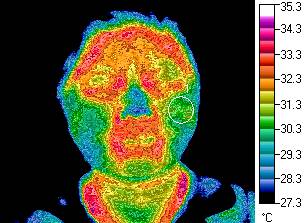
After Standard 15 min. cooldown at 72 degrees |
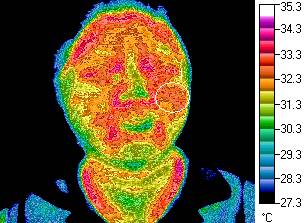
After 15 minute phone conversation on
unprotected cell phone |
|
|
|
1 |
2 |
3 |
4 |
5 |
6 |
|
1 |
2 |
3 |
4 |
5 |
6 |
|
Type |
Circle |
None |
None |
None |
None |
None |
Type |
Circle |
None |
None |
None |
None |
None |
|
Maximum |
31.0°C |
|
|
|
|
|
Maximum |
33.2°C |
|
|
|
|
|
|
Average |
30.5°C |
|
|
|
|
|
Average |
32.4°C |
|
|
|
|
|
|
Minimum |
29.8°C |
|
|
|
|
|
Minimum |
28.5°C |
|
|
|
|
|
|
Std. Dev |
0.255 |
|
|
|
|
|
Std. Dev |
0.523 |
|
|
|
|
|
More About the Autonomic
Nervous System
The branch of the autonomic
nervous system known as the sympathetic nervous system has the job of
maintaining a normal level of constriction in the blood vessels. This is known
as sympathetic tone. A stress to the sympathetic nervous system, such as
plunging the hands in ice water, will cause additional blood vessel constriction
and a cooling affect will be seen in a healthy sympathetic nervous system. The
sympathetic nervous system may be stressed and overreactive, causing more
vasoconstriction than optimal for a longer period of time than usual. The other
branch of the autonomic nervous system, the parasympathetic nervous system may
also become damaged or stressed and be unable to overcome the sympathetic tone
or overreaction and this may also contribute to excessive cooling for a long
period of time or permanently. Exhaustion of the sympathetic nervous system
from repeated severe stresses (physical and/or emotional) will be seen as a
dilatation of the blood vessels and a heating effect, because the sympathetic
nervous system is too depleted to maintain tone.
Autonomic Cold Challenge
If the autonomic nervous system
is stressed by radiation inducing heat, thermography can be used to test
autonomic response. The Cold Challenge has been used for many years in
thermography to shock and activate the autonomic nervous system by putting the
hands in ice water for one minute. Other autonomic challenges that have been
tested are: holding ice packs for one minute, another is asking those being
imaged to think about something stressful. A normal response is sympathetically
induced vasoconstriction, decreased blood supply to the skin, seen on the images
as cooling.
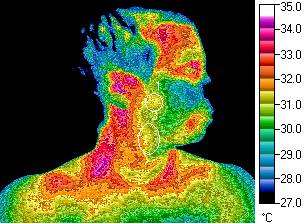
The following images show
radiation stress followed by autonomic cold challenge.
|
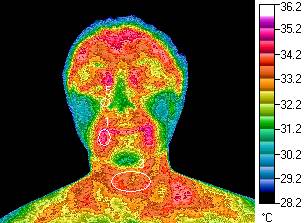
After exposure to unprotected cell phone
radiation for 15 minutes. |
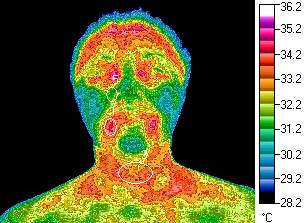
After cold challenge following the imaging at
left. |
|
|
|
1 |
2 |
3 |
4 |
5 |
6 |
|
1 |
2 |
3 |
4 |
5 |
6 |
|
Type |
Circle |
None |
Circle |
None |
Circle |
None |
Type |
Circle |
None |
Circle |
None |
Circle |
None |
|
Maximum |
35.3°C |
|
34.4°C |
|
33.3°C |
|
Maximum |
34.6°C |
|
34.3°C |
|
32.6°C |
|
|
Average |
34.4°C |
|
33.7°C |
|
32.5°C |
|
Average |
34.0°C |
|
33.5°C |
|
31.6°C |
|
|
Minimum |
33.7°C |
|
33.0°C |
|
31.4°C |
|
Minimum |
33.3°C |
|
32.6°C |
|
31.0°C |
|
|
Std. Dev |
0.292 |
|
0.278 |
|
0.440 |
|
Std. Dev |
0.294 |
|
0.353 |
|
0.329 |
|
| |
|
|
|
|
|
|
|
|
|
|
|
|
|
|
There is a decrease in sinus heat of .9 degrees C
following the cold challenge. The decrease in heat indicates the sympathetic
nervous system is functioning, but it is a large decrease suggesting that this
person's sympathetic nervous system is stressed.
|
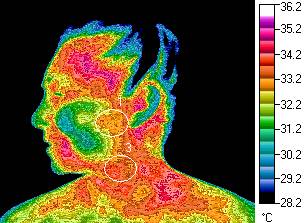
After Exposure to an Unprotected Cell Phone
|
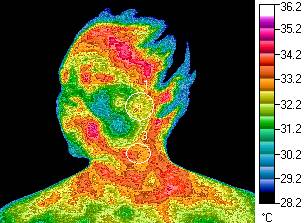
After Cold Challenge, captured after the
image at left |
|
|
|
1 |
2 |
3 |
4 |
5 |
6 |
|
1 |
2 |
3 |
4 |
5 |
6 |
|
Type |
Circle |
None |
Circle |
None |
None |
None |
Type |
Circle |
None |
Circle |
None |
None |
None |
|
Maximum |
33.9°C |
|
34.3°C |
|
|
|
Maximum |
33.4°C |
|
34.1°C |
|
|
|
|
Average |
33.0°C |
|
33.6°C |
|
|
|
Average |
32.4°C |
|
33.3°C |
|
|
|
|
Minimum |
31.9°C |
|
32.9°C |
|
|
|
Minimum |
31.5°C |
|
32.6°C |
|
|
|
|
Std. Dev |
0.321 |
|
0.284 |
|
|
|
Std. Dev |
0.356 |
|
0.278 |
|
|
|
In the image above and right,
the area in front of the ear, the otic parasympathetic ganglion, decreases in
heat by .6 degrees C after the cold challenge. This seems to confirm that it is
the irritation of the autonomic nervous system that causes the heat seen in
the infrared images after radiation exposure. Heat from any other cause
would not change after cold challenge.
The location of the radiation
induced heat changes is also of interest. No matter if it is radiation from the
home electrical box, a home satellite dish, wifi, a digital clock or riding in
an electrical car such as the Prius, the heat patterns seen in the thermal
images are consistent. The heat patterns seen from hundreds of radiation
exposure images are heat patterns in front of the ear, the location of the
otic ganglion and frequently heat in the parotid gland which receives
nerve supply from the otic ganglion. There is consistently heat in the
submandibular glands and often in the submandibular ganglion. There
is heat in the nasal sinuses and lacrimal glands from the
pterygopalatine ganglion and lateral eye heat especially on the favored side
from cell or cordless exposure from the ciliary ganglion. These are the
major parasympathetic ganglia in the head.
|
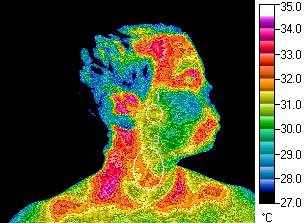
After Standard Cool Down
|
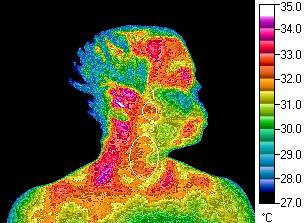
After talking on an unprotected cordless
telephone for 15 minutes |
|
|
|
1 |
2 |
3 |
4 |
5 |
6 |
|
1 |
2 |
3 |
4 |
5 |
6 |
|
Type |
Circle |
None |
Circle |
None |
None |
None |
Type |
Circle |
None |
Circle |
None |
None |
None |
|
Maximum |
31.5°C |
|
32.4°C |
|
|
|
Maximum |
32.3°C |
|
32.7°C |
|
|
|
|
Average |
31.1°C |
|
31.5°C |
|
|
|
Average |
31.9°C |
|
31.8°C |
|
|
|
|
Minimum |
30.5°C |
|
30.1°C |
|
|
|
Minimum |
31.5°C |
|
30.5°C |
|
|
|
|
Std. Dev |
0.228 |
|
0.457 |
|
|
|
Std. Dev |
0.194 |
|
0.457 |
|
|
|
Here there is a .8 degree
increase in heat after talking on the cordless phone in the otic ganglion area,
and a .3 degree heat increase in the submandibular glands.
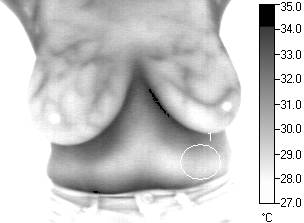
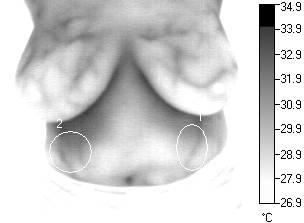
In addition, there are typical
colon heat patterns that are elicited from non-ionizing radiation (often
correlating to wearing a cell phone or pager on the belt or in a pants pocket).
These may be also related to autonomic irritation, but they are nonetheless high
risk, pre-cancer type patterns.
|
Ant. Breast
|
Post. Thoracic Breast
|
Effects of Radiation Protection Devices that
Strengthen the Autonomic Nervous System
If radiation demonstrably
stresses the autonomic nervous system, can radiation protection devices that
strengthen and balance the autonomic nervous system reduce the radiation caused
heat seen in the thermographic images?
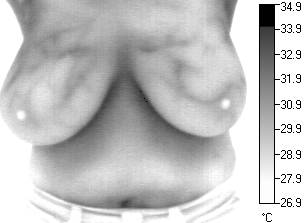
Here is the follow-up to the
breast and abdominal image above after talking on the same cordless telephone
with the addition of BioPro universal chip on the instrument and the base. Now
there are less high risk markings in the breasts and the colon high risk
markings are no longer present.
|
After 15 minute conversation on protected
cordless telephone
|
|
After Standard Cool Down
|
After 15 minute conversation on an
unprotected cordless telephone
|
|
|
|
1 |
2 |
3 |
4 |
5 |
6 |
|
1 |
2 |
3 |
4 |
5 |
6 |
|
Type |
Circle |
None |
Circle |
None |
None |
None |
Type |
Circle |
None |
Circle |
None |
None |
None |
|
Maximum |
31.5°C |
|
32.4°C |
|
|
|
Maximum |
32.3°C |
|
32.7°C |
|
|
|
|
Average |
31.1°C |
|
31.5°C |
|
|
|
Average |
31.9°C |
|
31.8°C |
|
|
|
|
Minimum |
30.5°C |
|
30.1°C |
|
|
|
Minimum |
31.5°C |
|
30.5°C |
|
|
|
|
Std. Dev |
0.228 |
|
0.457 |
|
|
|
Std. Dev |
0.194 |
|
0.457 |
|
|
|
|
After a 15 minute conversation on a BioPro
protected cordless telephone following the unprotected one above.
|
|
|
|
1 |
2 |
3 |
4 |
5 |
6 |
|
|
Type |
Circle |
None |
Circle |
None |
None |
None |
|
|
Maximum |
31.8°C |
|
32.1°C |
|
|
|
|
|
Average |
31.2°C |
|
31.2°C |
|
|
|
|
|
Minimum |
30.6°C |
|
30.2°C |
|
|
|
|
|
Std. Dev |
0.237 |
|
0.390 |
|
|
|
|
The BioPro non-ionizing
radiation protection devices do show protection against the autonomic irritation
caused by the cordless telephone.
|
This is the image taken after standard cool
down and cell phone exposure for 15 minutes seen earlier
|
This is the same image seen earlier after a
cold challenge showing a significant response by her stressed but
functional sympathetic nervous system
|
|
|
|
1 |
2 |
3 |
4 |
5 |
6 |
|
1 |
2 |
3 |
4 |
5 |
6 |
|
Type |
Circle |
None |
Circle |
None |
Circle |
None |
Type |
Circle |
None |
Circle |
None |
Circle |
None |
|
Maximum |
35.3°C |
|
34.4°C |
|
33.3°C |
|
Maximum |
34.6°C |
|
34.3°C |
|
32.6°C |
|
|
Average |
34.4°C |
|
33.7°C |
|
32.5°C |
|
Average |
34.0°C |
|
33.5°C |
|
31.6°C |
|
|
Minimum |
33.7°C |
|
33.0°C |
|
31.4°C |
|
Minimum |
33.3°C |
|
32.6°C |
|
31.0°C |
|
|
Std. Dev |
0.292 |
|
0.278 |
|
0.440 |
|
Std. Dev |
0.294 |
|
0.353 |
|
0.329 |
|
| |
|
|
|
|
|
|
|
|
|
|
|
|
|
|
|
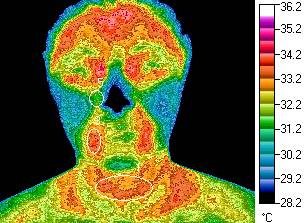
This is the same woman after adding a BioPro
chip to her cell phone and having another 15 minute conversation. She
has a more optimal cooling pattern than simply from the shock of the
cold challenge in the image above, by .3 degrees in the sinuses, by .7
degrees in the lymphatics under the chin
|
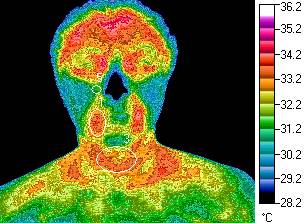
After cold challenge again following the use
of the BioPro protected phone, the sympathetic nervous system has
stabilized and shows a mild normal decrease in heat in the mouth area,
but no large reaction from a stressed autonomic nervous system
|
|
|
|
1 |
2 |
3 |
4 |
5 |
6 |
|
1 |
2 |
3 |
4 |
5 |
6 |
|
Type |
Circle |
None |
Circle |
None |
Circle |
None |
Type |
Circle |
None |
Circle |
None |
Circle |
None |
|
Maximum |
34.0°C |
|
34.0°C |
|
32.4°C |
|
Maximum |
34.0°C |
|
33.9°C |
|
31.9°C |
|
|
Average |
33.3°C |
|
33.5°C |
|
31.3°C |
|
Average |
33.3°C |
|
33.2°C |
|
31.4°C |
|
|
Minimum |
32.5°C |
|
32.8°C |
|
29.3°C |
|
Minimum |
32.1°C |
|
31.5°C |
|
30.8°C |
|
|
Std. Dev |
0.250 |
|
0.262 |
|
0.539 |
|
Std. Dev |
0.397 |
|
0.404 |
|
0.254 |
|
| |
|
|
|
|
|
|
|
|
|
|
|
|
|
|
The BioPro radiation protection
devices seem to strengthen and balance the autonomic nervous system.
Mouth Heat
Mouth heat is commonly seen in
post radiation images and after daily radiation exposure after the standard cool
down. Mouth heat may be caused by a dental infection (usually a single area of
heat), denture irritation ( can be a single area or the entire mouth when
severe), clenching (generalized heat) or temporomandibular joint heat seen in
front of and close to the ear, but superior to the otic ganglion. The heat seen
after radiation exposure seems to be from radiation activated dental materials
and is often seen draining into the lymph glands under the chin.
|
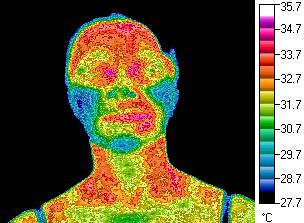
Documented Severe Dental Infection in lower
left mouth
|
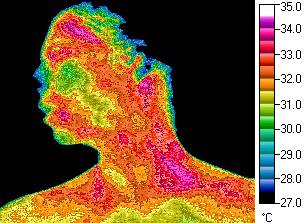
This woman has had a recent dental
examination with no dental infections, dentures or tmj problem, but she
is exposed at work to at least 8 hours per day of computers and wifi.
Note heat in the otic ganglion, parotid gland, submandibular glands and
in mouth draining into the lymphatics under the jaw
|
|
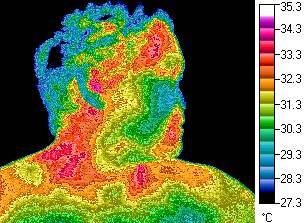
Documented temporomandibular joint heat. The
temporal branch of the facial nerve is superior and more medial to the
ear than the otic ganglion
|
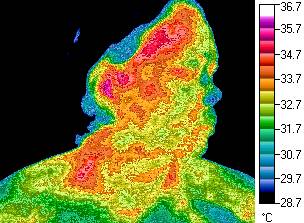
This woman works in front of a computer for 8
hours and uses her unprotected cordless phone there. Note heat in the
otic ganglion, parotid gland, sinuses, submandibular ganglia and mild
draining dental heat
|
|
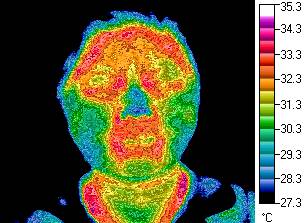
There is excess mouth heat seen after
standard cool down likely from accumulated exposures to radiation. She
has many metal fillings in her mouth |
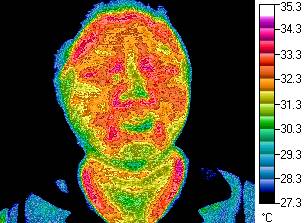
After talking on an unprotected cell phone
for 15 minutes, oral heat has increased significantly
|
|
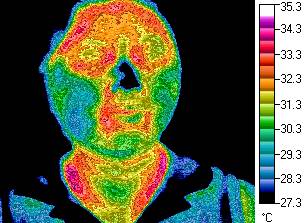
After talking on a BioPro protected cell
phone for 15 minutes there is less mouth heat than that seen after her
standard cool down. BioPro devices may help calm the excitation of
dental materials |
|
Autonomic Nervous System
Health is the Best Predictor of a Long Life Span
Autonomic nervous system
imbalances, oversensitivities and injuries cause some of the most difficult
problems in medicine. Radiation by itself or in conjunction with other toxins
or injuries can facilitate the autonomic nervous system to the point where
inappropriate and excessive responses are triggered by the slightest
provocation. Dr. Freddie Ulan, D.C., states "people with "blocked autonomic
regulation" are often not able to utilize even the best therapeutic
interventions, so continue on their dwindling spiral or simply just "can't get
well"." According to Dr. Guy Shenker, D.C., this creates a clinical picture
that can be "unpredictable with bizarre symptoms that come and go seemingly with
a mind of their own..." It is very helpful clinically to stabilize the
autonomic nervous system first, so that reactions to all treatment is optimized
and predictable. According to heart variability tests, a strong autonomic
nervous system is the best predictor of a healthy heart and a long life span.
Further Effects of
Non-Ionizing Radiation
The non-ionizing radiation we
are exposed to on a daily basis is cumulative. Multiple international studies
show that beyond or perhaps because of autonomic stress, non-ionizing radiation
can cause brain cancer (especially gliomas), acoustic neuromas, bladder cancer,
colorectal cancer, melanoma, leukemia, non-Hodgkin's lymphoma, male and female
breast cancer, prostate cancer and single and double stranded DNA breakage.
Additional studies show it causes hormone distress through effects on the pineal
gland that decrease melatonin production and allow an increase in estrogen.
Recent Russian studies show non-ionizing radiation to cause disruption of
memory, decline of attention and learning, increased epileptic readiness, sleep
problems and increased sensitivity to stress. In a collection of studies over
the last thirty years from Dr. Neil Cherry, he lists increased Down's Syndrome
from parental exposure, infertility, miscarriage, premature birth, heart
arythymias, acute myocardial infarction, calcium ion efflux and gaba fluxuation
at the cell membrane. Most of these studies have been verified by two to four
independent labs.
I have imaged several other
devices purporting to protect against radiation, but have found only the BioPro
products to be reliable at protecting and helping heal radiation effects. This
is the only company that produces a suite of products that not only protect
against radiation, but also heal radiation's effects on cell membranes (allowing
optimal absorption and detoxification), blood brain barrier, inter-cellular
communication, depletion of Heat Shock Proteins, as well as nerve repair of all
kinds.
For more information see:
My Websites: www.MyBioPro.com/doctorlinda,
www.HolisticCare Hawaii.com
The Facts:
www.Bioinitiative.org, www.emfhealthsolutions.com, www.neilcherry.com
The Technology:
www.bioenergetics institute.com